Ways to choose the right regional center for your EB-5 Investment Amount
EB-5 Visa Explained: How to Acquire a Visa Through Investment
The EB-5 Visa program offers an unique opportunity for foreign capitalists looking for U.S. long-term residency through a structured investment method. With specific eligibility standards and investment limits, the process needs mindful consideration and critical preparation. Understanding the nuances of the application procedure, consisting of the distinctions between local centers and direct investments, is crucial for prospective applicants. As this pathway unravels, possible capitalists need to navigate numerous benefits and challenges that accompany it. What are the essential elements that can influence the success of an EB-5 application?
Introduction of EB-5 Visa
The EB-5 Visa program, created to stimulate the united state economy with foreign financial investment, uses a pathway to permanent residency for qualified investors and their households. Developed by the Migration Act of 1990, the program intends to bring in international capital to produce jobs and improve financial growth in the United States. Financiers who contribute a minimum quantity to an accepted project can obtain this visa, therefore allowing them to purchase various sectors, including genuine estate, infrastructure, and other commercial enterprises.
The EB-5 program is particularly appealing due to its double advantages: a possibility for economic returns on investments and the potential for U.S. citizenship. By investing in targeted employment areas (TEAs), which are specified as rural regions or locations with high joblessness, capitalists may get a reduced financial investment limit. The program calls for the creation of at the very least ten full time work for united state employees as a straight result of the investment. Successful applicants obtain a conditional visa for two years, after which they can make an application for permanent residency, offered they fulfill all program demands. This path has actually garnered interest from financiers internationally, making it a crucial element of united state immigration policy.
Qualification Requirements
To receive the EB-5 Visa, investors need to satisfy certain eligibility criteria that assure their financial investment adds to work production and financial growth in the United States - EB-5. Most importantly, candidates have to spend a minimum of $1 million in a brand-new company, or $500,000 if the investment is made in a targeted employment location (TEA), which is commonly identified by high joblessness or rural locations
Furthermore, the venture needs to maintain or create at the very least ten full time work for qualifying united state workers within 2 years of the financier's admission to the United States. Capitalists are additionally needed to demonstrate that their financial investment funds were gotten with lawful ways, supplying proof such as income tax return and bank declarations.
Another essential requirement is that the investment needs to remain in a for-profit service entity that was established after November 29, 1990, or one that has actually been reorganized or increased to satisfy the EB-5 needs. Finally, candidates should show their intent to proactively take part in business, making sure that their participation adds to its success. Satisfying these qualification requirements is necessary for capitalists looking for to get permanent residency with the EB-5 program.
Financial investment Options
When considering the EB-5 visa, financiers should review their alternatives between straight investment chances and local facility programs. Each choice lugs particular job development requirements that are vital for fulfilling the visa criteria. Comprehending these investment opportunities is important for making a notified choice that lines up with both economic objectives and migration purposes.
Direct Financial Investment Opportunities
Direct financial investment possibilities under the EB-5 Visa program give foreign investors with a pathway to obtain united state long-term residency while adding to the American economy. Unlike regional center financial investments, direct financial investments call for capitalists to actively manage their service ventures within the united state, permitting prospective greater control and impact over their investment outcomes.
To receive the EB-5 Visa through direct financial investment, foreign nationals have to spend a minimum of $1 million in a brand-new company or $500,000 in a targeted employment location, which is specified as a backwoods or a region with high joblessness. The investment has to cause the creation of at the very least 10 full time jobs for qualifying united state employees within 2 years.
Straight financial investment choices can vary commonly, encompassing markets such as real estate development, production, hospitality, and technology startups. Capitalists need to conduct comprehensive due persistance to analyze the practicality of their selected service model and guarantee conformity with EB-5 policies. Involving with monetary and lawful specialists experienced in EB-5 issues is advisable to navigate the complexities of straight investment opportunities and maximize the possibility for an effective application.
Regional Center Programs
Leveraging the EB-5 Visa program, regional center programs offer a streamlined investment method for foreign nationals seeking U.S. permanent residency. These programs are marked by the U.S. Citizenship and Immigration Provider (USCIS) and concentrate on pooling investments to fund various economic growth tasks, which may consist of property, infrastructure, and service ventures.
Capitalists typically contribute a minimum of $900,000 in targeted work areas or $1.8 million in other regions. EB-5 Investment Amount. Among the main benefits of regional center programs is that they permit investors to fulfill the EB-5 investment needs with indirect job production, as opposed to guide task development required in straight investment chances
Regional focuses take care of the investment on part of the capitalists, offering an extra passive method than straight investment. This administration consists of managing task development, financial coverage, and compliance with USCIS guidelines. In addition, local centers frequently have established track records, boosting the self-confidence of potential investors.
Eventually, local center programs provide an engaging option for those looking to browse the complexities of the EB-5 Visa procedure while contributing to united state economic development and task production.
Job Production Demands
To get approved for an EB-5 Visa, financiers have to confirm that their resources investment leads to the creation of at least 10 full time work for U.S. employees within 2 years. This task creation demand is an essential element of the EB-5 program, created to stimulate the U.S. economic situation and advertise economic development.
Financiers can pick between 2 key investment alternatives: direct financial investments and investments via Regional Centers. With straight financial investments, the investor has to proactively manage the service and warranty work development, while likewise showing that the tasks produced are for united state residents or authorized long-term residents. On The Other Hand, Regional Facility investments permit investors to merge their sources right into a marked project, frequently resulting in indirect task development, which can be counted towards fulfilling the task demand.
To efficiently satisfy the job development requirements, it is essential for capitalists to work carefully with seasoned experts that can lead them through the intricacies of the EB-5 program. Correct preparation and adherence to policies are essential to confirm compliance and safeguard a path to irreversible residency. Failing to meet these job production needs can endanger the financier's EB-5 application and their immigration status.
The Application Process
The application process for the EB-5 visa includes a collection of essential steps and certain qualification needs that candidates have to meet. Recognizing these criteria is important for an effective application. This section will describe the necessary credentials and provide a step-by-step overview to guiding with the procedure.

Eligibility Needs Summary
Recognizing the eligibility requirements for the EB-5 visa is essential for possible capitalists wanting to get permanent residency in the USA. To qualify, a private need to show a minimal financial investment of $1 million in a brand-new company, or $500,000 if the financial investment is made in a Targeted Work Location (TEA), which is specified as a country area or one with high unemployment.
Moreover, the capitalist should reveal that the financial investment will certainly preserve or produce a minimum of 10 full time tasks for united state employees within 2 years of the investment. The enterprise must additionally be a for-profit entity and should be newly developed or significantly redesigned if it is an existing business.
The candidate should show that the investment funds are gotten with lawful methods, including personal financial savings, presents, or lendings sustained by correct documents. In addition, the capitalist needs to actively take part in the service, guaranteeing their interaction in the monitoring of the business. Meeting these qualification requirements is essential for an effective EB-5 application and ultimately safeguarding a permit through this financial investment opportunity.
Step-by-Step Treatment
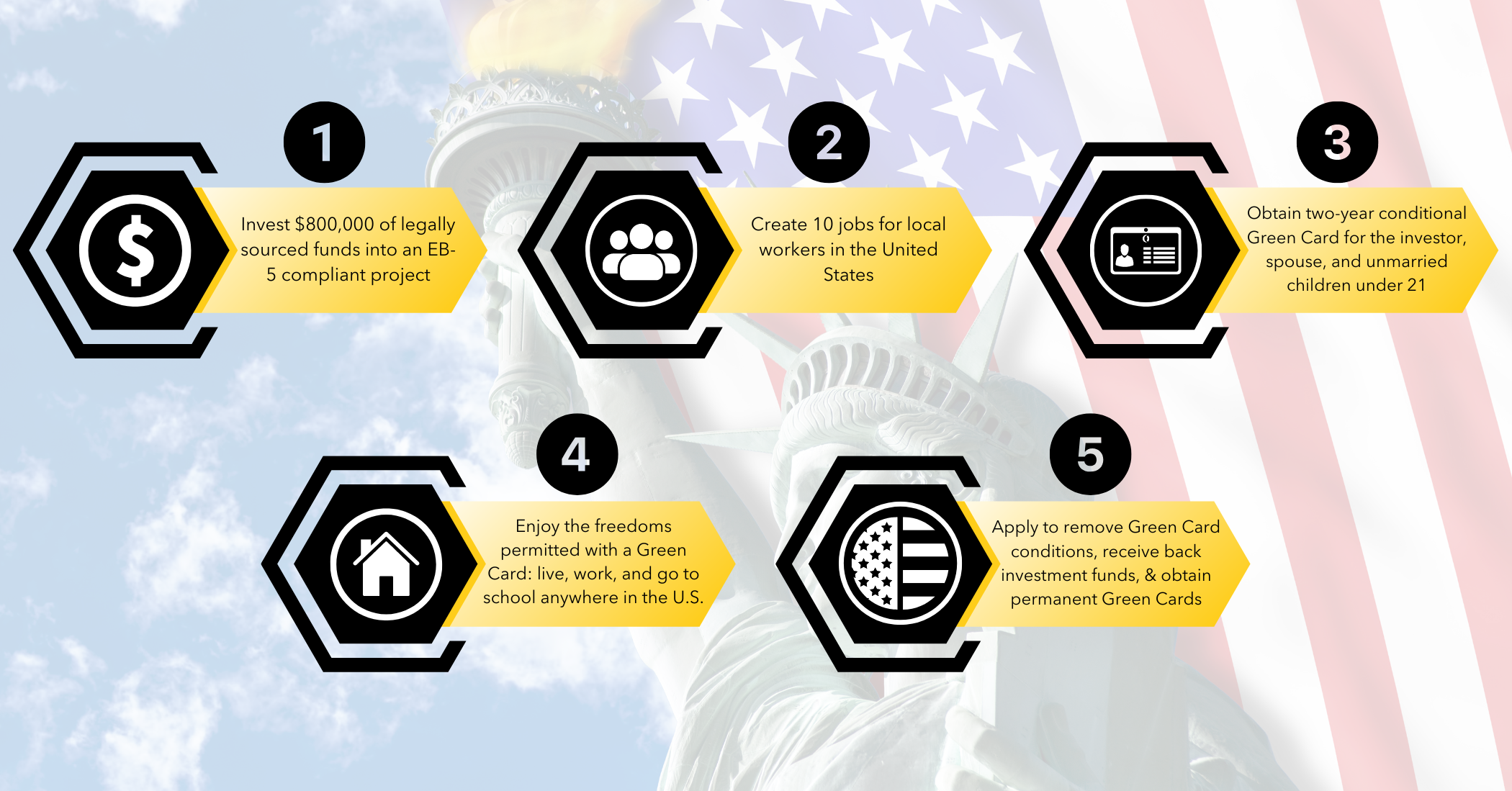
When eligibility demands are fulfilled, possible capitalists can begin the application procedure for the EB-5 visa. The very first step includes completing Form I-526, the Immigrant Request by Alien Capitalist. This kind has to be gone along with by sustaining documentation that demonstrates the capitalist's qualifying financial investment and the creation of a minimum of ten permanent jobs for united state workers.
Upon authorization of Form I-526 by the United States Citizenship and Migration Provider (USCIS), financiers can get the EB-5 visa with either consular handling or modification of condition, relying on their existing residency. For those outside the U.S., this means sending a visa at a united state consular office. Alternatively, if already in the U.S., applicants must file Type I-485, Application to Register Permanent Home or Change Standing.
After approval, investors and their eligible relative get conditional long-term residency for 2 years. Within 90 days prior to the expiration of this conditional status, financiers must file Type I-829, Request by Entrepreneur to Remove Problems, to get permanent residency. Successful completion of this step completes the EB-5 financial investment procedure, providing the investor a Visa.
Regional Centers vs. Direct Investments
Steering the EB-5 visa program includes a vital decision between local facilities and direct investments, each offering unique pathways to getting irreversible residency in the USA - EB-5 Visa by Investment. Regional facilities are marked by the United States Citizenship and Immigration Provider (USCIS) to advertise financial development via task production. When investing with a regional center, financiers usually contribute to a pooled fund, which is handled by the. This choice frequently permits a more easy financial investment technique, as the facility looks after the task and task creation needs
In comparison, direct financial investments need financiers to proactively handle their own service ventures in the United States. This technique requires a much more hands-on involvement, as the financier needs to produce and sustain at the very least 10 full time tasks straight relevant to their service. While straight investments may offer greater control over the financial investment result, they likewise entail higher risks and obligations.
Ultimately, the option between straight financial investments and regional centers copyrights on specific danger tolerance, wanted involvement degree, and financial investment goals. Comprehending these differences is essential for financiers seeking to navigate the intricacies of the EB-5 visa program successfully.
Advantages of the EB-5 Visa
The EB-5 visa program uses many advantages for international financiers looking for long-term residency in the USA. One of one of the most considerable advantages is the possibility for investors and their prompt member of the family, consisting of partners and kids under 21, to get an environment-friendly card, giving them the right to function and live in the U.S. forever.
The EB-5 program does not require an enroller, permitting investors greater freedom in their immigration trip. This program also supplies a path to citizenship after 5 years of long-term residency, promoting long-term stability for family members. In addition, investing through designated Regional Centers can be less cumbersome, as these entities typically take care of the task and job development needs in behalf of the capitalist.
Moreover, the EB-5 visa can bring about significant financial returns, as investments are usually directed toward business that can generate revenues. By adding to financial growth and work production in the United state, EB-5 investors play a necessary function in improving local communities. In general, the EB-5 visa acts as a compelling option for those seeking to safeguard a future in the USA while making a positive impact.
Typical Difficulties and Considerations
While the EB-5 visa program presents appealing benefits for foreign financiers, it likewise features its share of difficulties and factors to consider that possible candidates need to carefully review. One substantial difficulty is the economic commitment involved, as the minimal investment amount is significant, normally set at $1 million or $500,000 in targeted work areas. Financiers must ensure that they have adequate resources and a clear understanding of the linked risks.
Possible financiers have to perform detailed due persistance on the investment jobs to avoid illegal plans. The success of an EB-5 application copyrights on the development of at the very least ten full-time tasks for U.S. employees, demanding mindful planning and surveillance of the service's performance (EB-5 Investment Amount). Eventually, maneuvering these obstacles needs a why not try this out tactical approach and usually the support of knowledgeable professionals in migration and investment law
Frequently Asked Inquiries
For how long Does the EB-5 Visa Process Typically Take?

Can Family Members Members Apply With the Primary EB-5 Candidate?
Yes, member of the family can use along with the primary applicant. EB-5 Visa by Investment. Eligible dependents usually consist of spouses and single children under 21, permitting them to obtain permits contingent upon the key candidate's effective visa authorization
What Takes place if My Investment Falls short?
If your financial investment fails, it might endanger your migration standing and the possibility for acquiring a copyright. It's necessary to carry out detailed due persistance and consider risk mitigation strategies prior to proceeding with any type of investment.
Exist Age Restrictions for EB-5 Investors?
There are no certain age restrictions for EB-5 financiers; nevertheless, the private must go to least 18 years of ages to lawfully get in into financial investment agreements. Minors may certify with adult financial investment and sponsorship.
Can I Traveling Outside the U.S. During the Application Process?
Taking a trip outside the united state during the application process may impact your condition. It is suggested to speak with an immigration lawyer to recognize potential risks and guarantee compliance with all needs while your application is pending.
Regional focuses take care of the financial investment on behalf of the investors, offering an extra easy method than direct financial investment. To qualify for an EB-5 Visa, financiers should validate that their funding financial investment results in the development of at least 10 permanent work for U.S. employees within two years. Financiers can select between 2 primary financial investment options: direct investments and investments through Regional Centers. The financier needs to reveal that the investment will certainly create or protect at the very least ten full time tasks for U.S. workers within two years of the investment. Ultimately, the option between regional centers and straight investments copyrights on private threat resistance, desired involvement degree, and financial investment objectives.